
The Untouchable 'Mr. Golf'
Byron Nelson's play 80 years ago remains a beacon of excellence
Ask which tournaments prior to my lifetime I would love to have seen and it is predictable: Young Tom Morris dominating The Open Championships of 1869 and 1870 by 11 and 12 strokes; Gene Sarazen and Walter Hagen battling for the 1923 PGA Championship; Bobby Jones winning the Grand Slam in 1930; Ben Hogan’s Triple Crown of Masters, U.S. Open and Open of 1953; the 1960 U.S. Open, when Arnold Palmer, Jack Nicklaus and Ben Hogan met at a three-way intersection of golf eras with Palmer emerging as the swashbuckling victor.
Byron Nelson is on my list, too, for a slightly larger body of work.
Eighty years later, the golf that Nelson played over a 13-month period in 1945-46 stands out like a sequoia among saplings.
Nelson’s numbers over that span seem like typographical errors.
Beginning with a win at the Phoenix Open on Jan. 14, 1945, and ending with a win at the New Orleans Open on Feb. 17, 1946, Nelson had 21 victories in 33 starts, a winning percentage of 64 percent. And within that dazzling statistic, of course, are Nelson’s all-time PGA Tour records of 11 straight wins from March through August of ’45, and 18 overall titles that season, achievements that likely will never be matched or bettered. (Tiger Woods has come closest to his streak, winning seven consecutive starts in 2006-07, and Hogan totaled 13 wins in 1946.)
Since Scottie Scheffler will start the 2026 season next week having finished in the top eight in 15 consecutive starts—a run that has had him compared to Hogan’s consistent excellence during the early 1950s—it is worth noting that Nelson had 29 top-three finishes during those epic 13 months bookended by the wins in Phoenix and New Orleans.
Thirteen of Nelson’s 21 victories during that unprecedented span were by five or more strokes, which goes a long way toward why he was being referred to as “Mr. Golf.”
Nelson started 1946 as he ended 1945—by winning a tournament.
The wins and the close calls came at a time when good golf balls were hard to come by because rubber was prioritized for the war effort. Fairways had clover and dandelions. And greens were a far cry from today’s table-smooth surfaces. “The courses were pretty ragged,” tour player Johnny Bulla recalled to Golf World in 1995. “All of them were in bad shape.”
A master with his two-wood, Nelson ate up the par fives. “If there were 16 par 5s in a tournament,” Jug McSpaden once recalled, “you could bet he would be 10 to12 under par for those holes.” Playing by what his eyes saw rather than what a yardage-book told him, he was a superb judge of distance on his irons. With a trailblazing swing featuring a lot of leg drive, Nelson seldom got way off track. His consistency fed his confidence.
As James Dodson notes in American Triumvirate, his outstanding 2012 book about Nelson, Hogan and Sam Snead, the trio of greats born in 1912, Bobby Jones in the summer of ’44 had praised Nelson and hinted what might be coming because of Byron’s steadiness.
“It is my belief that Nelson is one of the greatest golfers the game has ever known,” Jones said. “He has that rarest of all qualities—consistency. Byron rarely has a bad day or a bad round. He has more finesse than any of the others … Hogan was the hardest worker I’ve ever seen on any golf course. He was the hardest worker I’ve seen in any sport. I’ve also felt that Sammy Snead was the greatest stylist I’ve ever seen. By stylist I mean the accomplishment of results with the least amount of effort. Snead has always been a fine artist. But it’s Nelson they all must watch and fear.”
Jones’s confidante and chronicler, O.B. Keeler coined “The Great Precisionist” to describe Nelson as he roared through the spring and summer of 1945, winning everything until Fred Haas Jr., an amateur, defeated him in Memphis in August. But Nelson would win the following week across Tennessee, in Knoxville, and three more times before the end of 1945, victory number 18 coming in Fort Worth in December by eight shots over Jimmy Demaret. Snead and Hogan finished 13 and 14 strokes, respectively, behind Nelson in that event at Glen Garden Country Club, where Nelson and Hogan had caddied as teenagers.
Those who throw shade at Nelson’s 1945 say shallow fields helped his cause. It’s true that he didn’t serve in the U.S. military after being ruled 4-F because his blood took far longer than normal to clot. Yet, his principal rivals who did serve, Hogan and Snead, weren’t absent in ’45. Hogan had 18 appearances that year, while Snead played in 28 events.
During 1945 and ’46, in fact, Nelson, Hogan and Snead racked up phenomenal numbers, combining for 52 wins and 94 top-three finishes over those two seasons: Nelson (24 wins, 38 top-threes), Hogan (18 and 34), Snead (10 and 22). As Dodson writes, it was “an unrivaled period of dominance by any trio of golfers.”
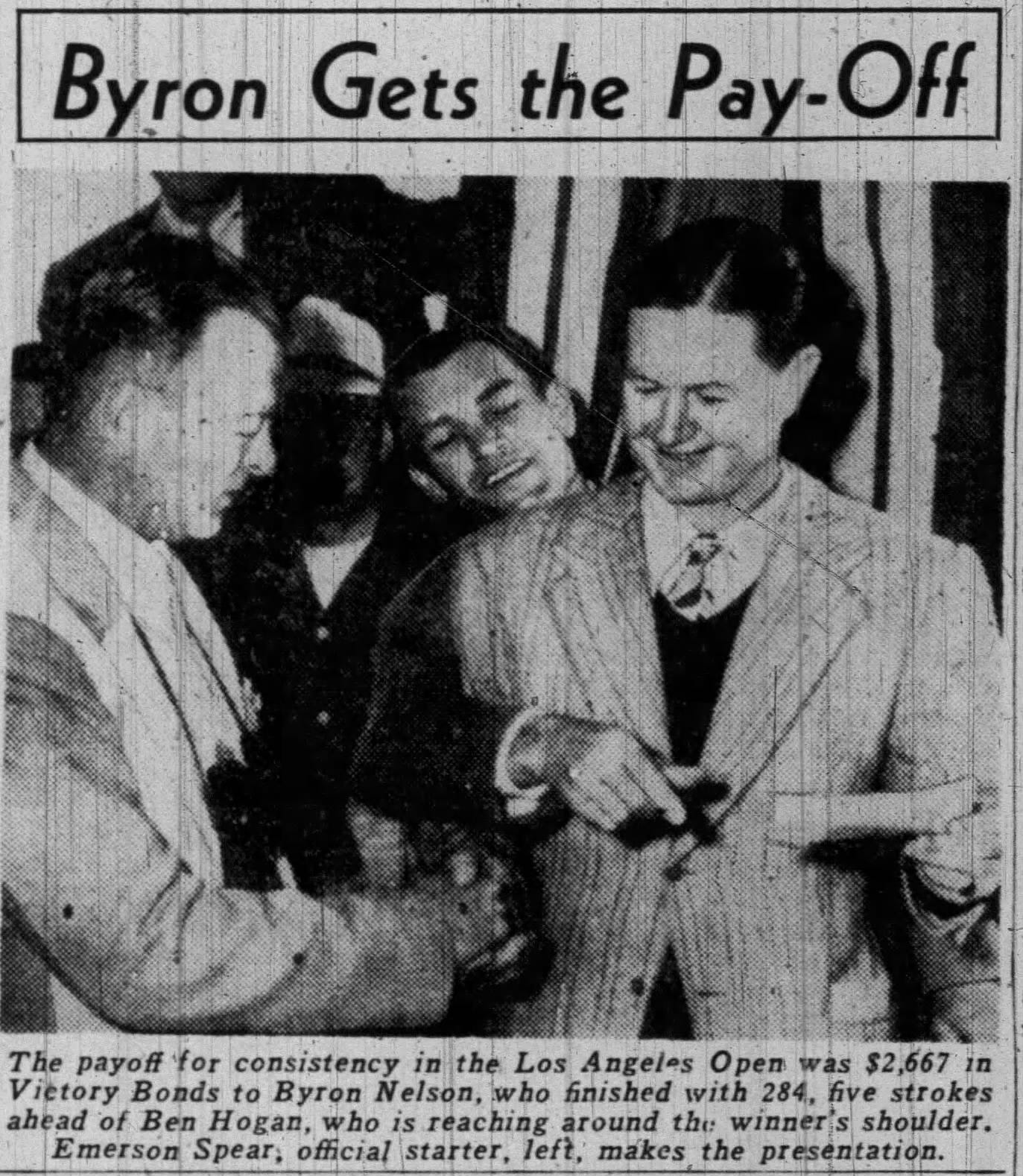
Hogan would turn out to be the tour’s best player in 1946, but the year began with him finishing a distant second, five behind Nelson, in the Los Angeles Open at Riviera Country Club. “Nelson played his usual steady game,” said a report in the Hollywood Citizen-News. “He didn’t get off any crowdwhooping drives but was always down the middle; he didn’t hit the pin with his approaches, but he was always on the green; and he sunk very few of those 20-foot putts, but he was always close.”
“It might have been boring,” Nelson said years later, “but I sure was eating regular.”
A win in San Francisco, third place in San Antonio and a win in New Orleans (where Hogan again was second, five back) completed Nelson’s fantastic 13 months in which he had victories in a dozen states and two Canadian provinces, a crowdwhooping stretch if there ever was one.